Overview
Our group has developed SOLVEG-R, a sophisticated computational model that predicts the movement of radioactive materials in the environment. Using this model, we've shed light on the mechanisms behind radioactive cesium contamination in forests affected by the Fukushima Daiichi nuclear disaster. We've also enabled predictions of cesium concentrations in forests where observation data is limited.
Existing forest cesium models often rely on observed data, limiting their applicability to the Fukushima region. This made it challenging to understand the long-term impact of the accident on tree contamination and how these concentrations might change over time. Our research introduces SOLVEG-R, which details the complex processes governing material movement within forests ‒ including water cycles and plant growth ‒ based on meteorological and soil conditions. This allows us to predict cesium movement in diverse forest types without relying solely on observational data.
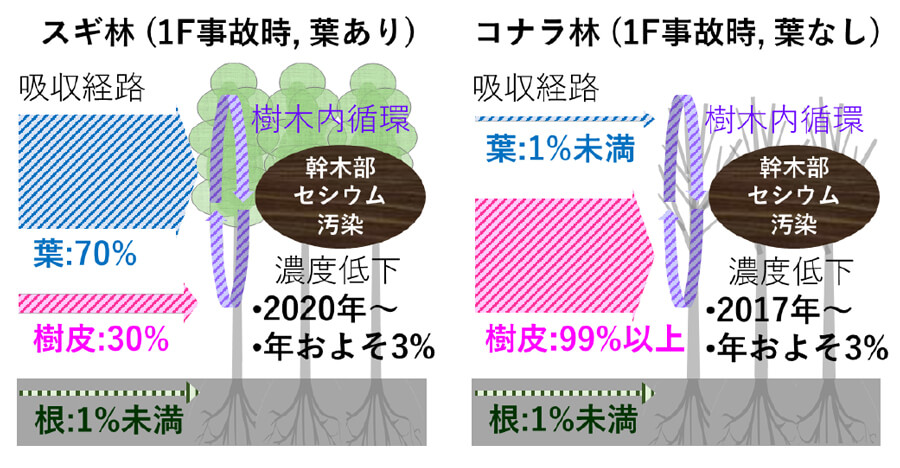
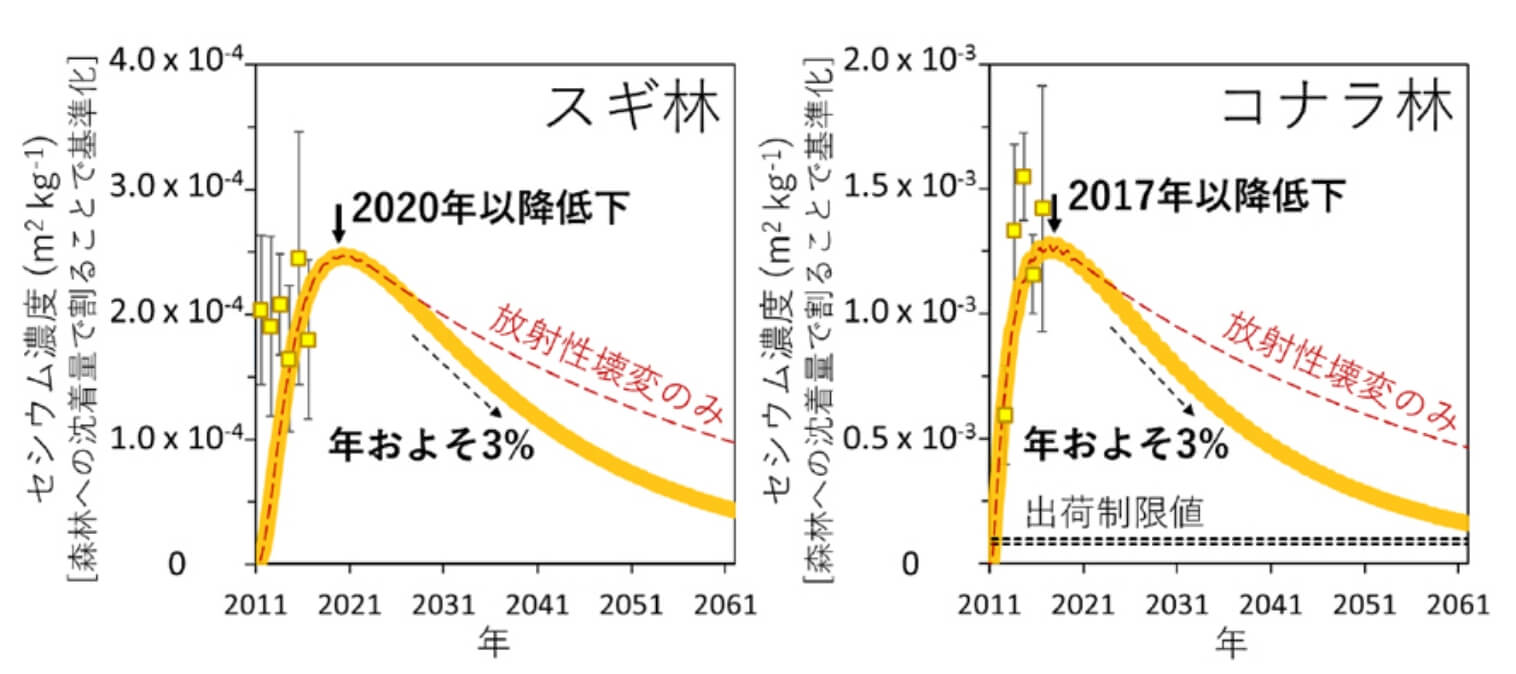
Analysis of SOLVEG-R simulations for Japanese cedar (Sugi) and Japanese oak (Konara) forests in Fukushima Prefecture revealed that radioactive cesium deposited on trees after the accident was absorbed through leaves and bark, eventually accumulating in the wood (Figure 1). We also found that cesium on the surface of leaves and bark is removed by rainfall and leaf fall, leading to a gradual decline in wood concentrations. This decline is projected to occur at an annual rate of 3%, driven by tree growth and dilution, faster than the annual radioactive decay rate of 2%.
While our model results show promising insights, further on-site investigations are necessary to validate the model's predictions, given discrepancies between model outputs and actual measurements, and the limited availability of data spanning only the first six years after the accident. We are committed to ongoing research and model refinement.
【SOLVEG-R ‒ Predicting Radioactive Cesium Movement in Forests】
This research developed a novel computational model, SOLVEG-R, to precisely predict the movement of radioactive cesium within forests. We applied this model to forests in Fukushima Prefecture, clarifying the mechanisms of tree contamination following the Fukushima Daiichi nuclear accident and projecting changes in contamination levels over the next 50 years. The key features of the SOLVEG-R model are:
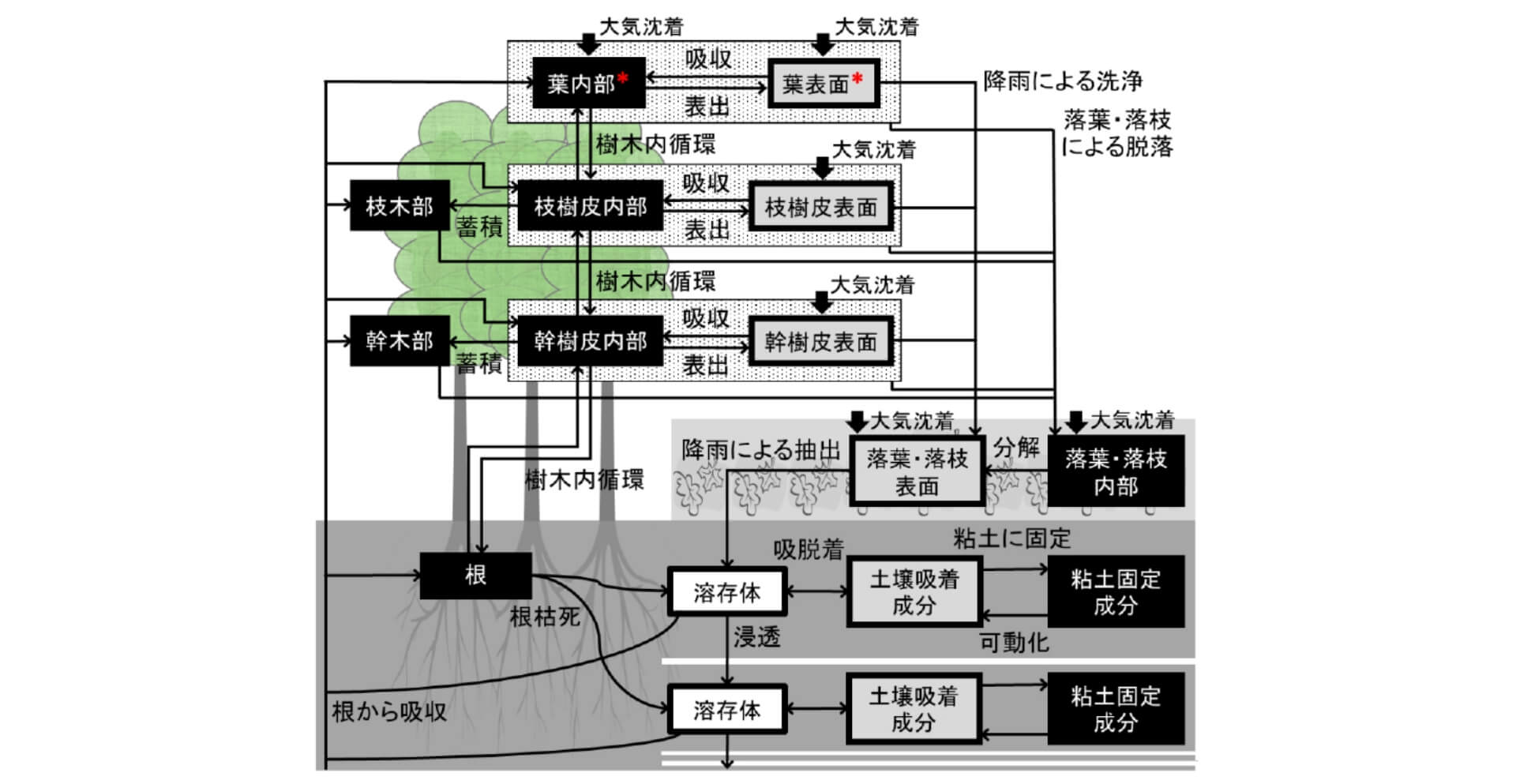
- Comprehensive Forest Simulation:The model simulates the movement of radioactive cesium within forests, including the influence of meteorological data on terrestrial water cycles and plant growth (Figure 2). This allows for calculations of cesium movement driven by water cycles and the impact of tree growth for any forest with available meteorological data, making it applicable to a wide range of forest types without relying on observational data.
- Detailed Partitioning of Tree Components:The model divides tree aboveground parts into numerous sections, enabling the specification of atmospheric deposition, rainfall wash, and internal absorption of radioactive cesium for each part. This allows for calculations of cesium movement between tree components, for example, differentiating between coniferous trees with foliage present during the Fukushima Daiichi accident and deciduous trees without foliage.
- Soil-Clay Interaction Consideration:The model accounts for the interaction of radioactive cesium with clay in the soil. This makes it applicable to forests in Fukushima Prefecture with clay-rich soils originating from volcanic ash.
This computational model was applied to artificial Japanese cedar forests in Fukushima Prefecture (with an initial deposition of 68 kBq/m2 of 137Cs following the Fukushima Daiichi accident) and natural Japanese oak forests (with an initial deposition of 510 kBq/m2). The results show that radioactive cesium levels increased not only in the directly deposited leaves, branches, and bark, but also in the inner wood of the trees from the immediate aftermath of the accident (Figure 3). This increase continued for approximately 10 years, largely corroborating observational data.
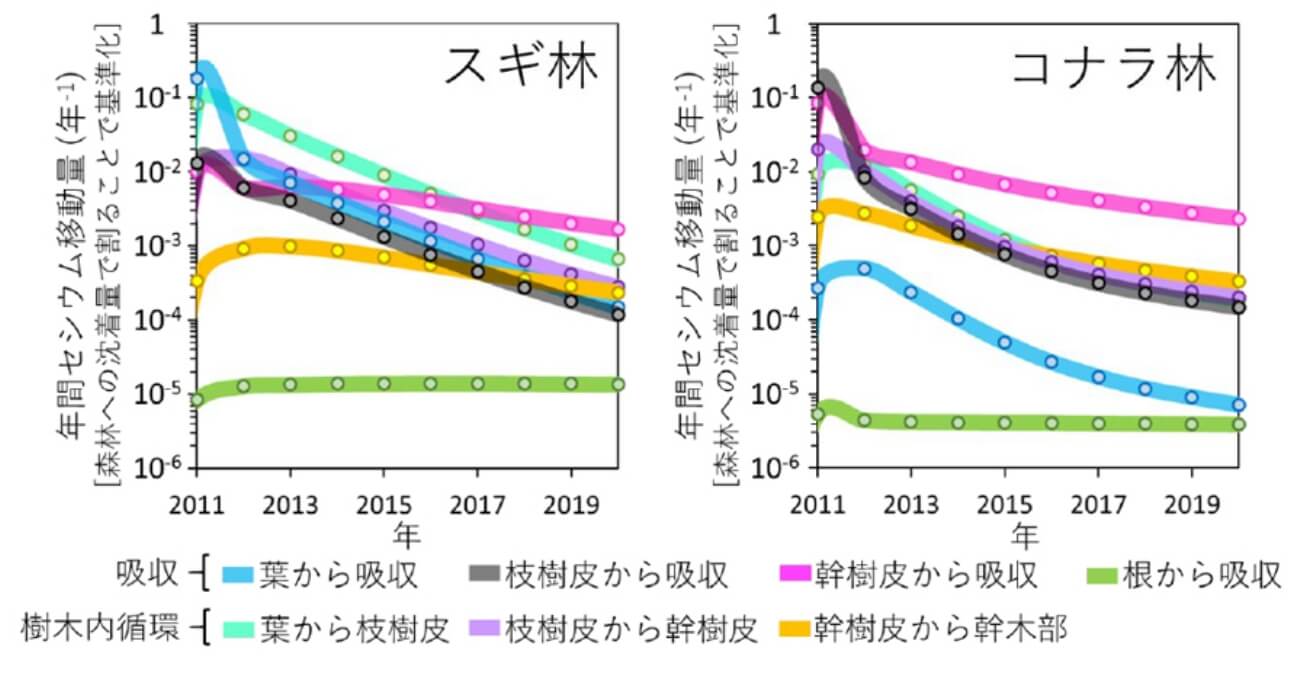
Analysis of radioactive cesium movement within the trees (Figure 4) indicates that cesium deposited on the tree surface was rapidly absorbed by the leaves (cedar) and bark (oak), circulating between different parts of the tree while some accumulated in the wood. For example, in cedar trees, cesium moved from the leaves to the bark, then to the inner wood. These findings reveal that the radiochemical cesium deposited on trees following the Fukushima Daiichi accident was the primary cause of the subsequent long-term contamination of tree wood.
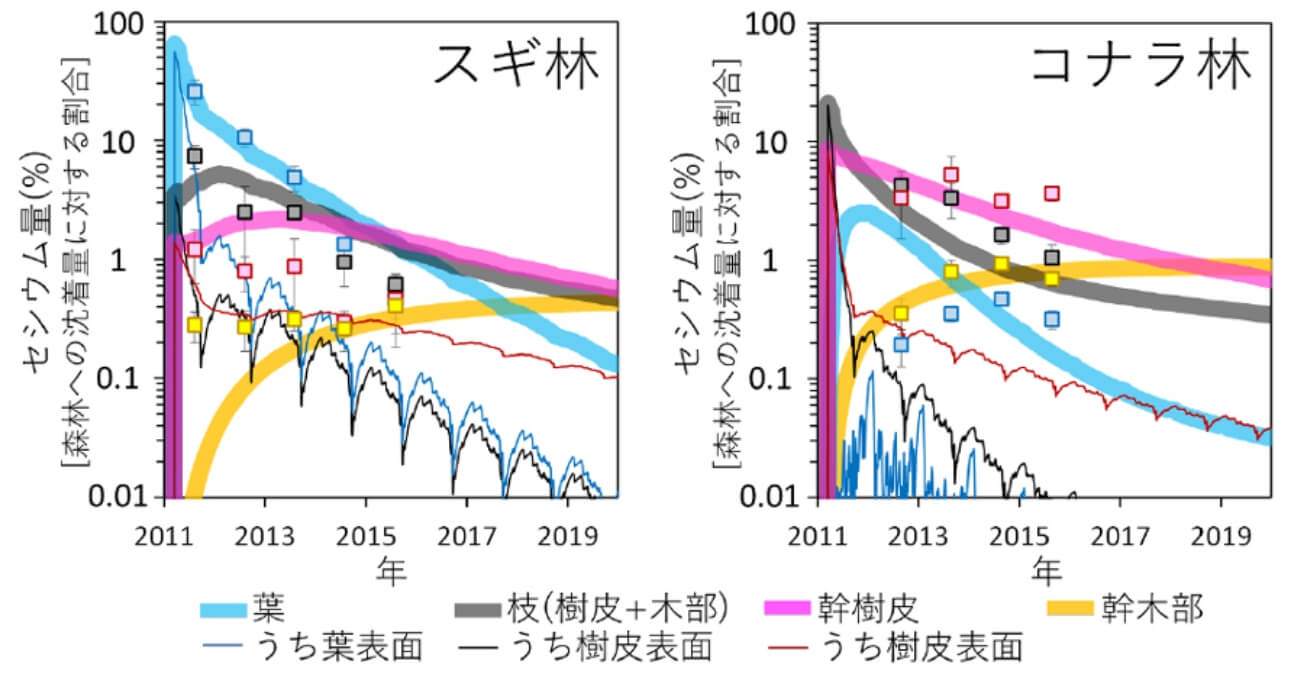
This model calculation extended over 50 years to predict future contamination trends. Radioactive cesium deposited on the bark and leaves, the initial source of wood contamination, was removed from the trees within a few years due to rainfall washing and leaf fall (dashed line in Figure. 3). Consequently, cesium concentration in oak trees began to decline from 2017 (Figure 5). In cedar trees, where cesium absorption primarily occurred through the leaves, it moved through the leaves and branches, leading to a slight delay in accumulation in the wood. Cesium concentration began to decline from 2020. This decline is attributed not only to radioactive decay (approximately 2% per year) of the accumulated cesium in the wood but also to tree growth (concentration dilution, approximately 1% per year). This resulted in a faster decline than solely due to decay (approximately 3% per year). Assuming this trend continues, the wood concentration in the targeted oak forest (initial atmospheric deposition of 510 kBq/m2) is projected to fall below the shipping limit (50 Bq/kg) by 2079 (68 years after the accident). However, due to discrepancies between model calculations and measurements, and the limited 6-year validation data (Figures 3 and 5), ongoing field surveys are necessary to refine the model predictions.
Furthermore, unique aspects of Fukushima forests were observed. Unlike Chernobyl, where root uptake became the primary factor in wood contamination within decades of the accident, root uptake remained low in the targeted Fukushima forests, accounting for less than 1% of the total 50-year tree uptake (Figure 4). This is likely due to the following characteristics of Fukushima forests:
- Abundant rainfall and rapid leaf decomposition led to the swift transfer of deposited radioactive cesium from the forest floor leaf layer to the soil.
- Clay-rich soil derived from volcanic ash fixed radioactive cesium, rendering it unavailable for root absorption.
Therefore, root uptake of radioactive cesium is minimal in Fukushima forests, suggesting that further increases in wood concentration are unlikely.
Code release information
SOLVEG-R can be obtained through the "PRODAS" computer program search system of the Japan Atomic Energy Agency (JAEA). To access this tool, please refer to the JAEA PRODAS system for instructions and availability. For more information, please consult the JAEA website or contact the relevant JAEA department.
References
Ota, M., Koarashi, J. (2022). 福島の森林資源における放射性セシウム汚染の新たな計算モデル構築. Isotope News, 784, 28-31. (Japanese only)