Overview
Our group has developed STEAMER (Short-Term Emergency Assessment system of Marine Environmental Radioactivity), an emergency system for rapidly predicting the ocean dispersal of radioactive materials in the event of an accident at nuclear facilities in Japan's surrounding waters.
STEAMER utilizes a proprietary ocean dispersal model and incorporates the latest meteorological sea forecast data from the Japan Meteorological Agency. By inputting information on the amount of radioactive material released, the system can predict the concentration of radioactive materials in seawater and seabed sediments up to one month in the future. This allows for the estimation of dispersal patterns from any location within Japan, including surrounding waters.
STEAMER can be combined with WSPEEDI, a global emergency environmental dose information prediction system developed by the same research group, to predict the distribution of radioactive materials that descend to the ocean via atmospheric deposition.
The system's high predictive performance was demonstrated during the analysis of marine contamination following the Fukushima Daiichi Nuclear Power Plant accident. While it took approximately three weeks to obtain results during the Fukushima accident, STEAMER can now provide prediction information within a few hours of starting the calculation.
STEAMER enables crucial support for emergency response by facilitating:
- Strategic placement of marine monitoring points based on predicted contamination.
- Estimation of released radioactive material amounts and reproduction of contamination distribution using marine monitoring data.
- Setting up exclusion zones and navigation restrictions based on these analyses.
- Detailed analysis of accidents to inform future preparedness.
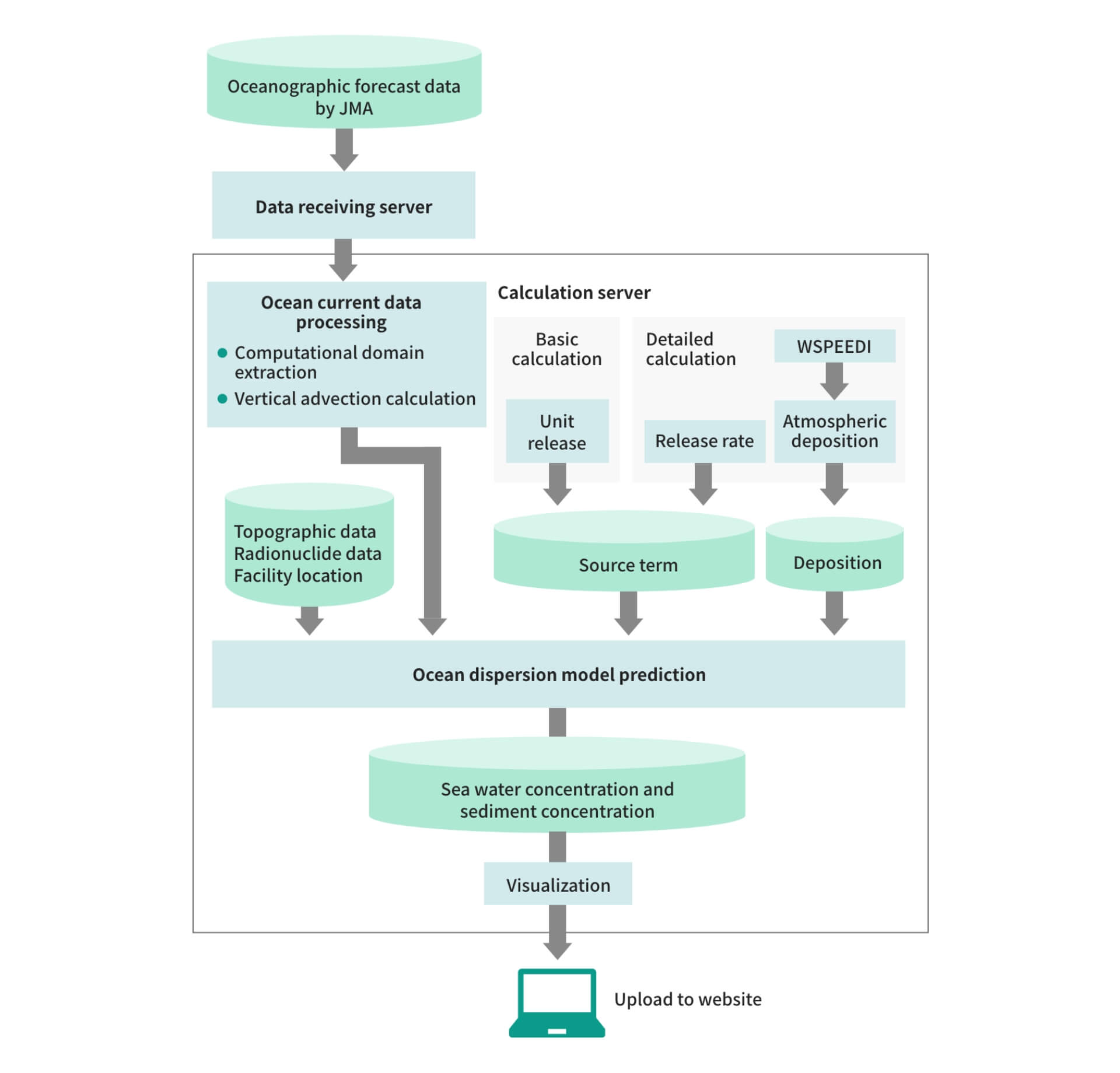
System configuration
STEAMER is a system that predicts the concentration of radioactive materials in seawater and seabed sediments up to one month in the future, based on meteorological sea forecast data by Japan Meteorological Agency and a marine dispersal model developed by Japan Atomic Energy Agency (JAEA), together with release information of radioactivity (Figure 1).
Basic Calculation Function:
- Pre-defined Locations: The system stores location information for nuclear facilities in Japan, East Asian countries, and US naval bases.
- Unit Release Condition: It can quickly perform ocean dispersal predictions using a unit release condition (continuous release of 1Bq/h dissolved material) for accidents at these facilities.
- Automated Pre-prediction: The system automatically runs pre-prediction calculations daily, simulating continuous releases for 24 and 30 hours, and 30 days after the event. The results are visualized and uploaded to a server.
Detailed Calculation Function:
- Flexible Parameters: For accidents outside the pre-defined locations, or when considering atmospheric deposition in addition to direct release, or when release amount information becomes available during the accident, detailed calculation parameters can be set.
- Configurable Conditions: These parameters include the type of radioactive material, location and depth of the release area, release mode (direct release to the ocean, atmospheric deposition via WSPEEDI, simultaneous direct and atmospheric release), and time-varying release amount information.
Applications:
The prediction information obtained from the basic and detailed calculation functions
is useful for:
- Setting up emergency marine monitoring points.
- Estimating the amount of radioactive material released into the ocean using the marine dispersal model and monitoring results.
- Estimating the amount of radioactive material released into the atmosphere using the atmospheric dispersal model, marine dispersal model, and atmospheric/marine monitoring results.
- Reproducing and forecasting the distribution of marine contamination based on the estimated release amount.
- Setting up no-fishing and navigation prohibited zones to prevent internal exposure from seafood and desalinated water.
Thus, STEAMER serves as a foundation for establishing an emergency response system for nuclear accidents in the ocean.
System performance evaluation
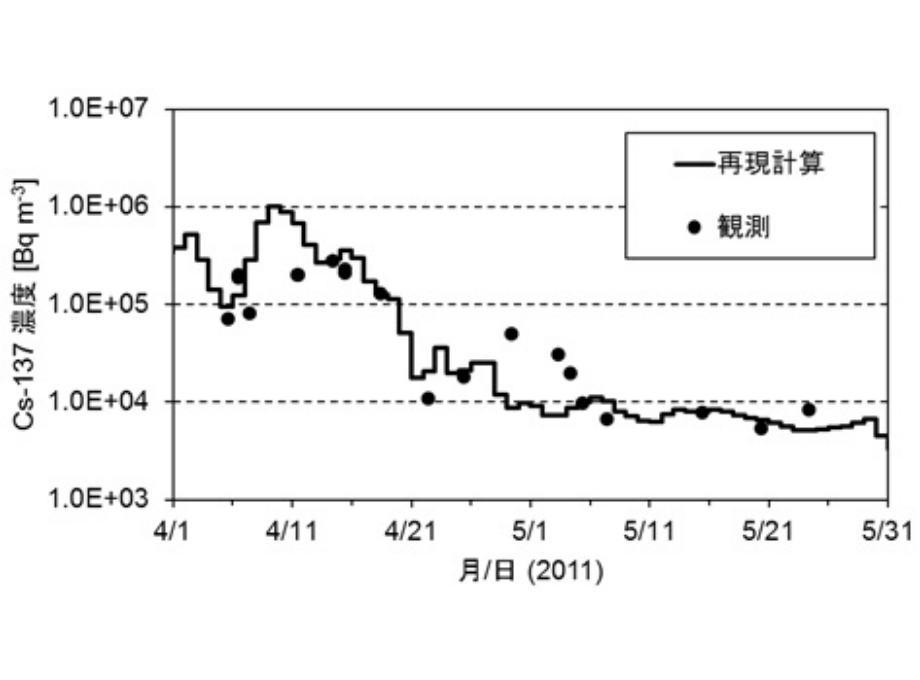
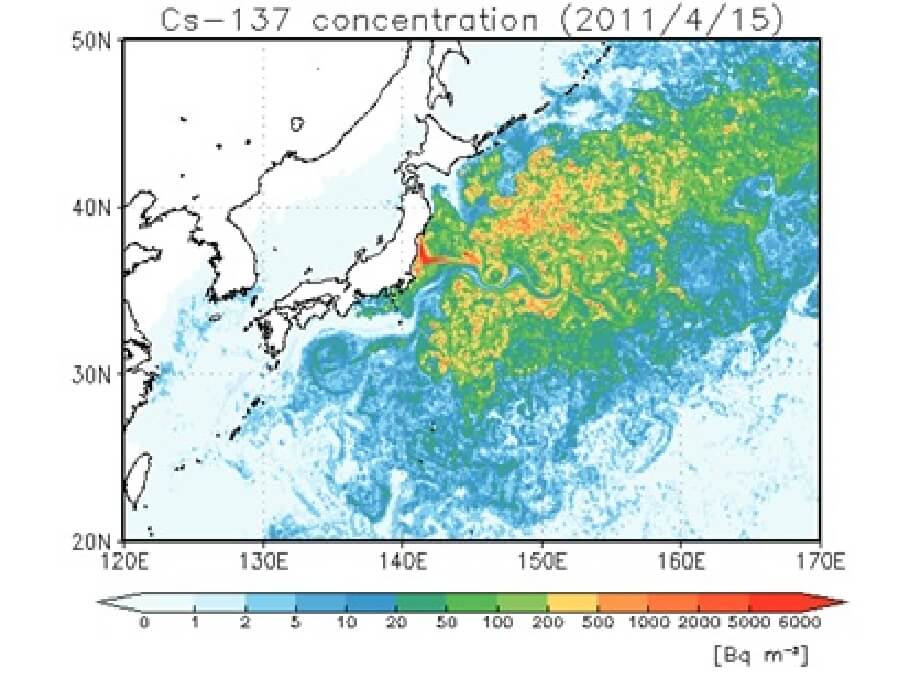
To verify the predictive performance of the core calculation model, a reproduction calculation of marine contamination caused by the Fukushima Daiichi Nuclear Power Plant accident was performed using the detailed calculation function. The calculation used atmospheric deposition and direct release amounts calculated by WSPEEDI, and the results showed good reproduction of monitoring values measured by Tokyo Electric Power Company, the Ministry of Education, Culture, Sports, Science and Technology, and various research institutions in the coastal and offshore areas of Honshu. Figure 2 shows a comparison between the calculated surface concentration of 137Cs at a monitoring point 17km offshore from the Fukushima Daiichi Nuclear Power Plant and the observed values. The figure shows that the reproduction calculation accurately reproduces the temporal changes in the observed values. Figure 3 shows the surface concentration distribution of 137Cs on April 15, 2011. The red high-concentration area extending eastward from the Fukushima coast is the diffusion of 137Cs directly released into the ocean from the facility. The concentration distribution spread across the entire Pacific Ocean, excluding the Fukushima coast, is due to atmospheric deposition of 137Cs and its subsequent diffusion into the ocean. Thus, STEAMER enables the visualization and understanding of 137Cs contamination conditions that are difficult to observe in reality.
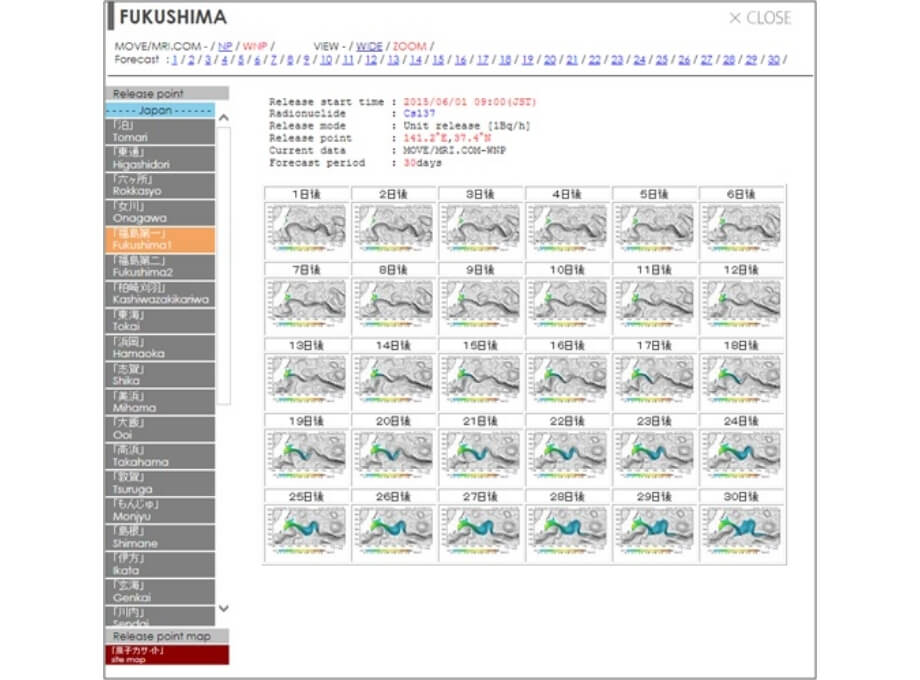
During the test operation, calculations simulating the direct release of 137Cs from a nuclear facility at a release rate of 1Bq/h to the ocean were performed daily using the automatic prediction function of this system (September 2014 - February 2017) to confirm the stability and robustness of STEAMER (Figure 4).
References
Kobayashi, T., Kawamura H., Kamidaira Y. (2020). Development of Short-Term Emergency Assessment system of Marine Environmental Radioactivity. ATOMOΣ, 62(11), 635-639. (Japanese only)