Overview
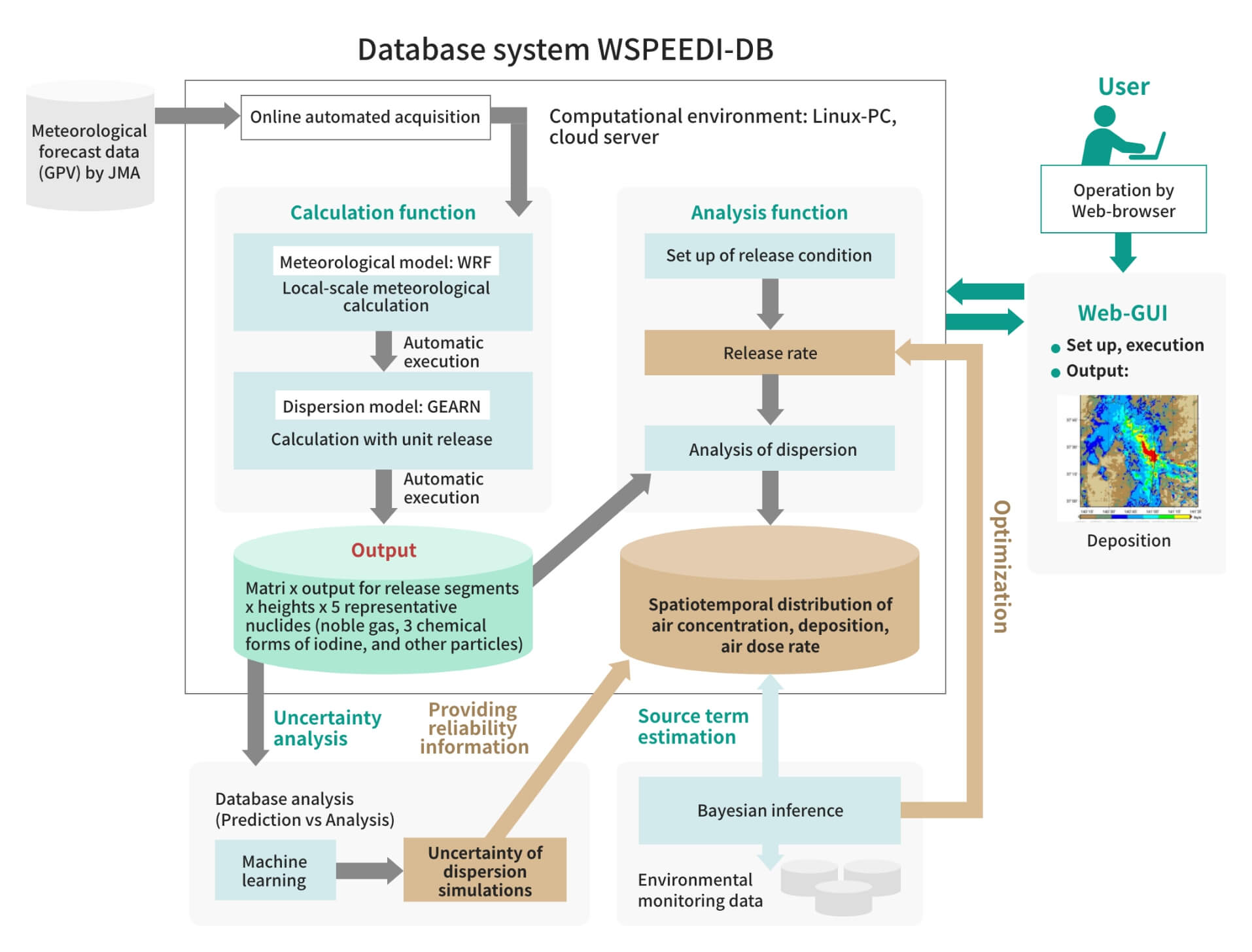
Our group has developed "WSPEEDI-DB," an atmospheric dispersion database system, to improve upon WSPEEDI, a global emergency environmental dose prediction system that forecasts the dispersal of radioactive materials in the atmosphere.
WSPEEDI-DB allows for the immediate retrieval of atmospheric dispersion simulation results for various meteorological conditions and arbitrary release source information, enabling a wide range of applications that were previously difficult.
The conventional WSPEEDI has a proven track record in applications such as predicting the dispersal of radioactive materials from nuclear power plant accidents and underground nuclear tests. Furthermore, the results of atmospheric dispersion simulations using WSPEEDI have been utilized for dose assessment and the development of monitoring plans. However, the dispersion prediction model used in WSPEEDI requires a significant amount of computational time to obtain results for various calculation conditions, making it difficult to compare and evaluate results under different conditions.
Therefore, to efficiently provide the results of atmospheric dispersion simulations using WSPEEDI, we have developed a new calculation method. This new method pre-computes and databases the results of numerous dispersion simulations, allowing for the immediate retrieval of atmospheric dispersion simulation results even when meteorological and release source conditions are changed. This enables efficient comparison and evaluation of simulation results under various conditions.
With WSPEEDI-DB, atmospheric dispersion calculations can be performed for arbitrary meteorological conditions up to several days in the future. This can be utilized for various studies related to the atmospheric dispersal of radioactive materials. In practice, this system has been used to verify the placement of monitoring posts around nuclear power plants, allowing for the proposal of effectiveness and improvement points.
Furthermore, atmospheric dispersion analysis using various hypothetical release source information makes it possible to understand events to be anticipated in training and to create simulated monitoring data for use in training based on the assumption of an accident.
In addition to the functions, this system can be extended to estimate emission source information through statistical analysis of dispersion calculation outputs and environmental monitoring data, as well as to evaluate uncertainty in future predictions using machine learning with long-term historical dispersion calculation output databases.
Calculation method
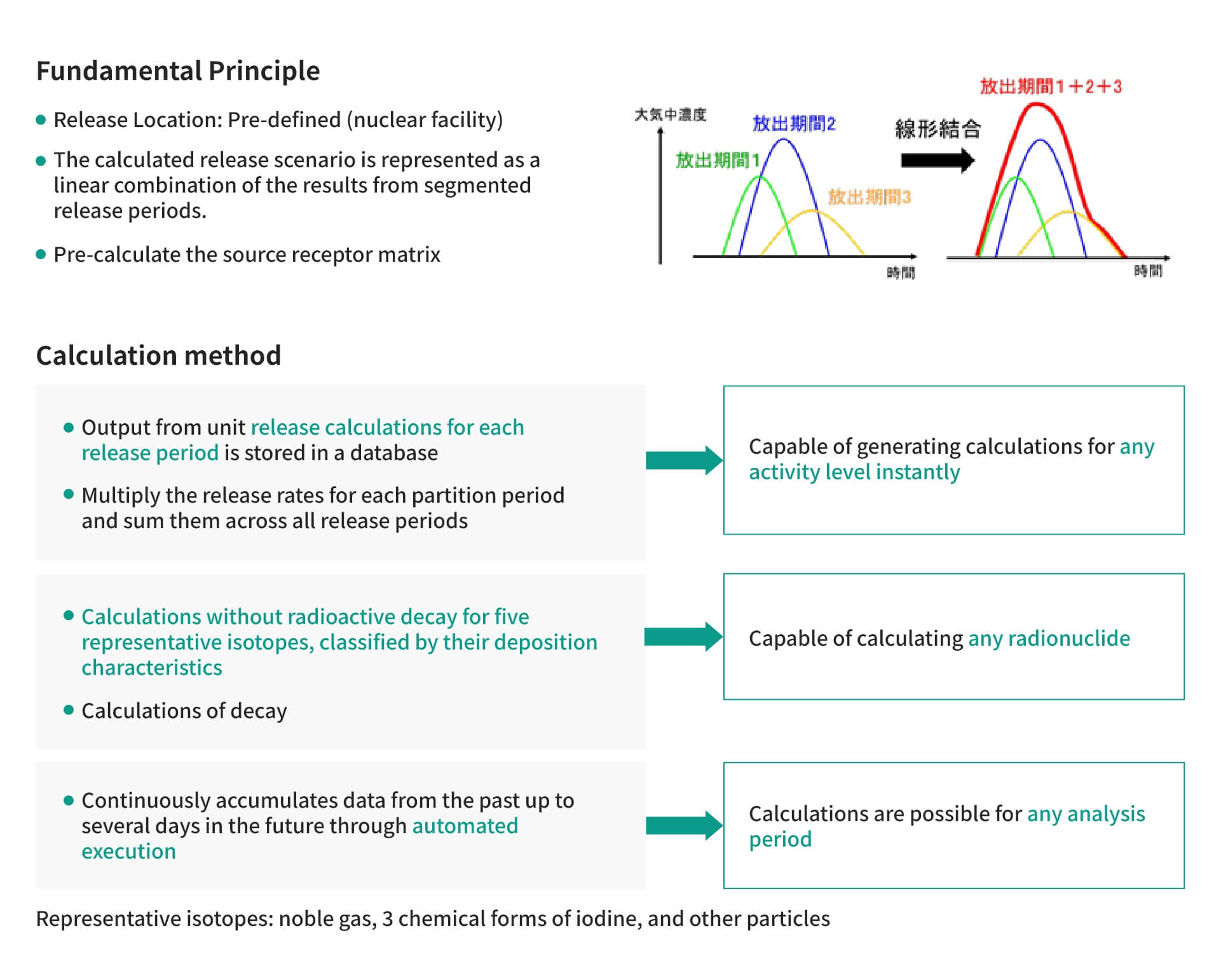
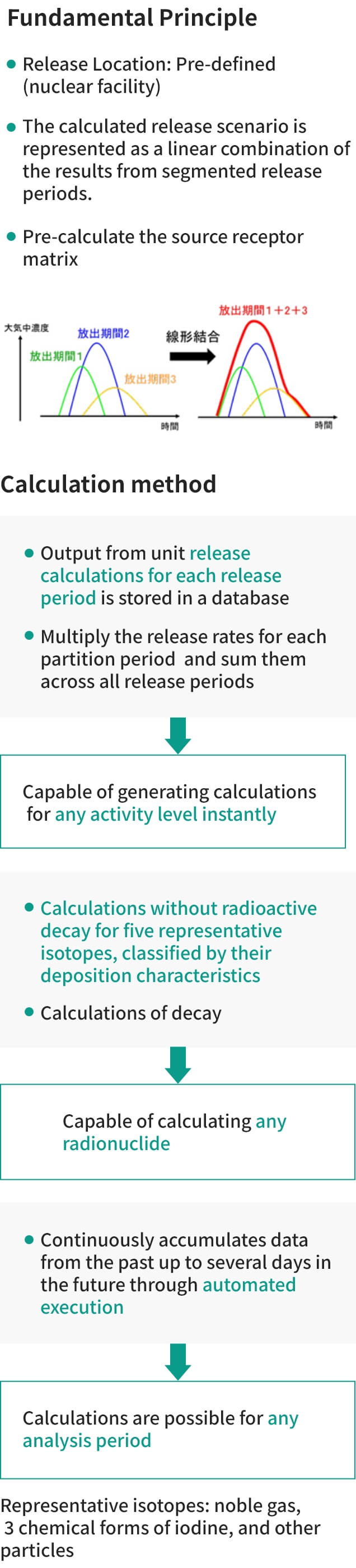
To enable immediate generation of detailed atmospheric dispersion calculation results for various conditions using WSPEEDI, we have developed a new dispersion calculation method (Figure 2). By creating a database of calculation results in advance from numerous diffusion calculations without specifying uncertain information other than the release point, such as the radionuclide, release rate, and release period, it is possible to instantly obtain predicted results based on set release conditions. The results of these calculations for all release scenarios are stored as a database, allowing for the immediate retrieval of predictions based on the set release conditions. While the basic concept of this calculation method has been used previously, this research further develops it by performing calculations in the following steps:
- Divide the release period into fixed intervals and calculate atmospheric dispersion under a unit release condition (1 Bq/h) for each interval. The results of all release period cases (unit release dispersion data) are saved as a database. For radioactive isotopes, group them into five categories with similar dispersion behaviors and perform calculations only for five representative isotopes from each group. These calculations are performed without considering radioactive decay, and the specified decay rate of the radioactive isotope is applied to the output results later, enabling the response to any radioactive isotope release.
- Continuously execute the above atmospheric dispersion calculations daily, updating with meteorological analysis and forecast data, and continuously accumulate the unit release dispersion data to establish a continuous database spanning from the past to several days in the future.
- When actual release conditions are provided, apply the release conditions to the unit release dispersion data for each interval. By summing the atmospheric dispersion calculation results obtained in each interval, atmospheric dispersion calculation results for arbitrary release conditions can be created.
Utilization of results
WSPEEDI-DB can generate atmospheric dispersion calculation results for various hypothetical release source information based on past meteorological conditions. This enables the following ways to utilize atmospheric dispersion calculation results:
- By analyzing the relationship between deposition and spatial dose rate distribution influenced by meteorological and topographical factors, we can better understand potential atmospheric dispersion events for training scenarios.
- Comparing calculated values at potential monitoring post locations and their surroundings allows us to explore more efficient monitoring methods that take into account topographical characteristics and meteorological conditions.
- By outputting spatial dose rate calculations from dispersion simulation results based on hypothetical accident scenarios with past actual meteorological conditions, we can create simulated monitoring data for training purposes. This allows us to confirm monitoring procedures and identify potential problems.
User interface
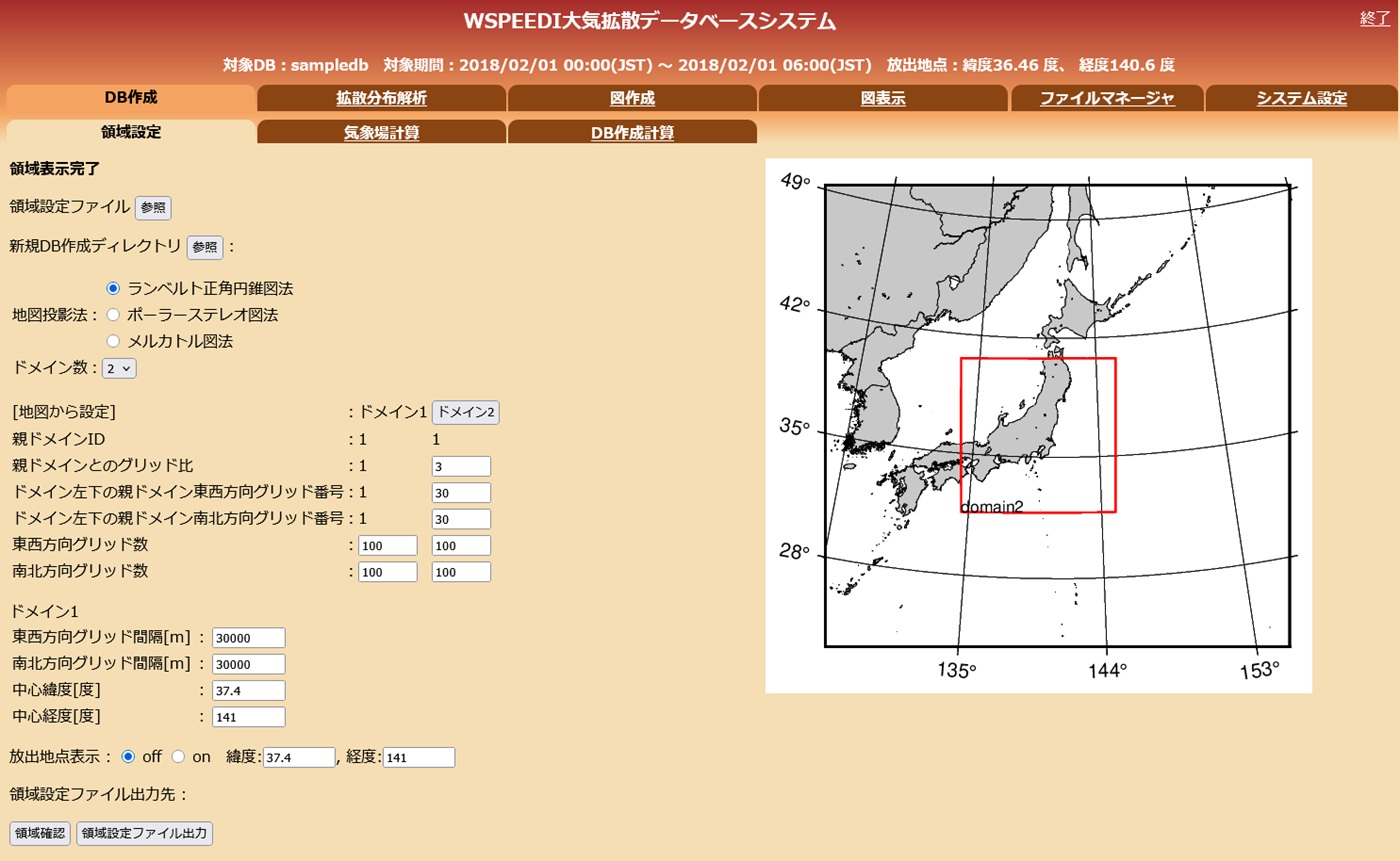
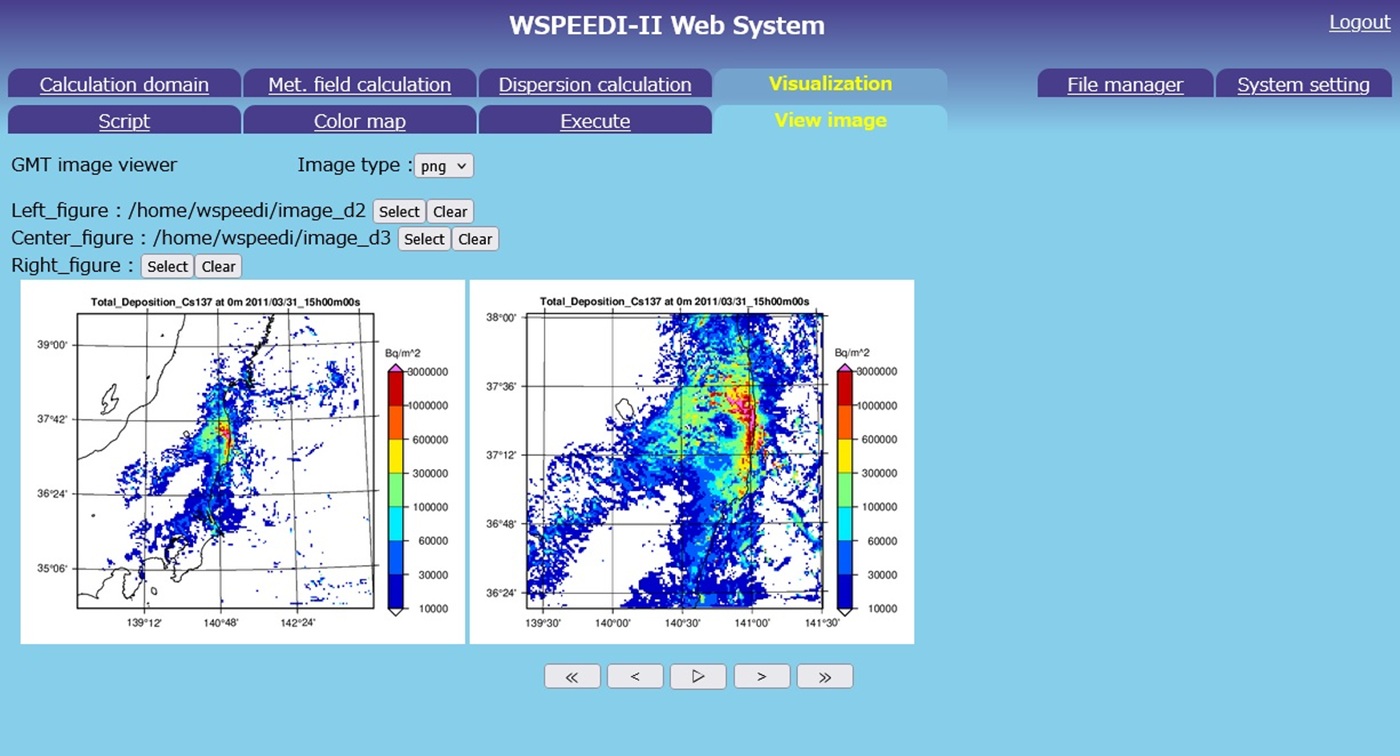
WSPEEDI-DB and WSPEEDI-II are web-browser based tools, enabling users to easily create input data for atmospheric dispersion simulations, execute simulations, and visualize output results (Figures 3 and 4). These tools are currently used by research institutions and universities both overseas and in Japan. They are also employed in technical training for international research and development organizations, as well as in research and development projects involving summer interns and students. Access to WSPEEDI-DB and WSPEEDI-II is available upon application. Please refer to the code release information for details.
Code release information
WSPEEDI-DB and WSPEEDI-II can be obtained through the "PRODAS" computer program search system of the Japan Atomic Energy Agency (JAEA). To access these tools, please refer to the JAEA PRODAS system for instructions and availability. For more information, please consult the JAEA website or contact the relevant JAEA department.